


HOT PRODUCT | LOW STOCK
Culinovia Kogane™ Japanese Tempura Fryer Pot
Culinovia Kogane™ Japanese Tempura Fryer Pot
Verfügbarkeit für Abholungen konnte nicht geladen werden
- Master payment method
- American express payment method
- Apple pay payment method
- Google pay payment method
- Shopify pay payment method
- Discover payment method
- Visa payment method
Lifetime Guarantee
Highest Quality
Material
TSA & EU Airline
Approved
PRODUCT DESCRIPTION
PRODUCT DESCRIPTION
You know the moment. The batter hits the oil and instead of a sharp crackle you get a slow, sad fizz.
Ten minutes later you're eating greasy shrimp and pouring half a bottle of oil down the drain.
That's not your cooking. That's your pan.
The Kogane is built the way Japanese kitchens have fried for a century — deep and narrow, so one quart of oil covers everything. A thermometer sits permanently in the oil, so you see 340°F instead of guessing at it with a wooden chopstick.
And the lid isn't just a lid. Flip it over and it becomes a draining rack that rests on the rim. Every drop runs straight back into the pot.
Fry chicken on Sunday. Strain the oil. Fry tempura Wednesday with the same oil.
304 stainless steel. No cord. No counter space. No plastic basket to scrub.
SIZE, VARIANTS & SPECS
SIZE, VARIANTS & SPECS
CHOOSE YOUR SIZE
- 2.3 Qt — Couple
8" / 20 cm diameter · 3.3" / 8.5 cm deep
Total capacity 2.2 L
Fill with 2.5–3.5 cups of oil
Feeds 1–2 people
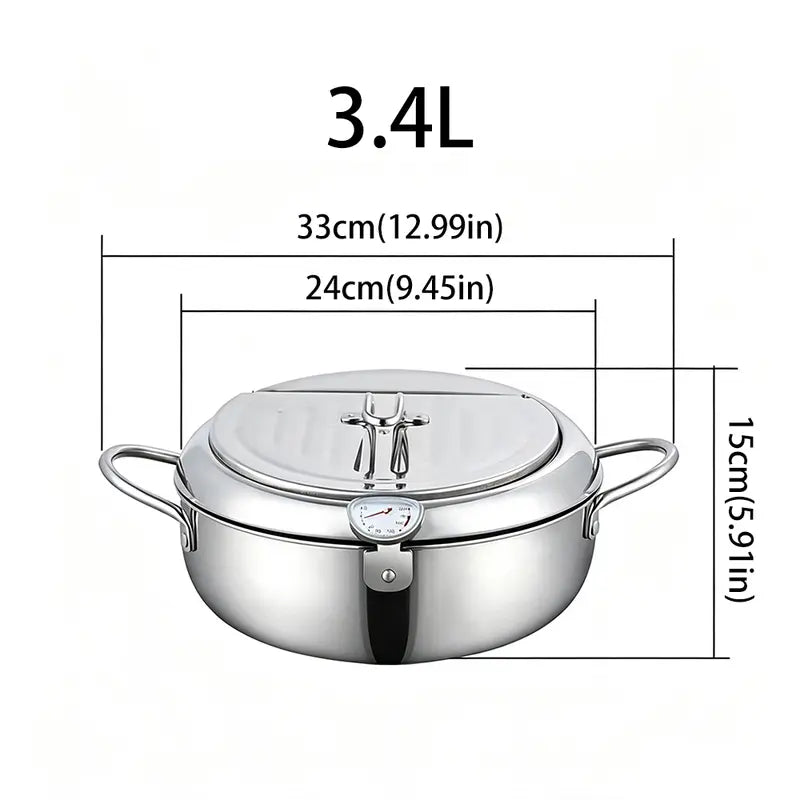
11" wide with handles - 3.6 Qt — Family
9.5" / 24 cm diameter · 3.9" / 10 cm deep
Total capacity 3.4 L
Fill with 4–5 cups of oil
Feeds 3–5 people
13" wide with handles
SPECS
- Material — Food-grade 304 stainless steel
- Thermometer — Dial gauge, 0–200°C, mounted in the oil, removable for cleaning
- Pour spout — V-shaped bypass, drip-free
- Handles — Cool-touch double loop
- Cooktops — Induction · Gas · Electric · Ceramic
- In the box — Pot · Flip-over lid with oil drip rack · Thermometer · Lid fixing buckle
- CA Prop 65 — No listed carcinogens or reproductive toxins
MATERIALS & FOOD SAFETY
MATERIALS & FOOD SAFETY
- 304 stainless steel (18/8) — the same grade used in commercial kitchens and food processing. Non-reactive, won't leach into oil at frying temps.
- No non-stick coating. Nothing to flake, chip, or break down above 500°F.
- No plastic in the hot zone. Handles and buckle are steel.
- Lead-free, PFOA-free, PTFE-free.
SHIPPING & RETURNS
SHIPPING & RETURNS
Free shipping on all US orders.
Ships in 1–2 business days. Delivery in 5–10 business days.
30-day money-back guarantee. Fry with it. If it doesn't change how your food comes out, send it back for a full refund — no restocking fee.
Arrived damaged? Email support@chillovia.com with a photo and we ship a replacement same day.

Culinovia Kogane™ Japanese Tempura Fryer Pot


PRECISE HEAT, EVERY SINGLE BATCH
Stop guessing at the oil & fry like a restaurant again — instantly
Without a thermometer sitting in the oil, there's no way to know if you're at 280°F or 360°F — and your batter won't tell you until it's already ruined.
This causes food to soak instead of seal, doubles the oil your dinner absorbs, and leaves the inside raw while the outside darkens — so every batch comes out heavy and greasy, and half a bottle of oil goes down the drain with it.
Frying in a deep Japanese-style pot with a built-in thermometer holds the oil at the exact temperature each food needs, sealing the crust the second it hits the surface. This cuts how much oil the food absorbs, keeps the coating light and audibly crisp, and leaves the oil clean enough to strain and reuse for three or four more meals.

The lid that keeps oil out of your dinner
Flip it over and it becomes a draining rack across the pot.
Here's what almost nobody knows about frying: your food doesn't absorb most of its oil in the pot. It absorbs it in the 60 seconds after you take it out.
While food is frying, escaping steam pushes outward and holds oil at the surface. The moment it leaves the oil, that steam stops — and as the food cools, the vapor inside condenses and creates a small vacuum that pulls the surface oil straight into the crust.
Which means what you do in that first minute decides how greasy your dinner is.
A paper towel is the worst possible answer. Food sits flat in its own oil, the underside steams against the paper and goes soft, and every drop you paid for gets thrown in the trash.
The Kogane's lid flips into a rack that sits across the pot mouth. Air circulates underneath. Gravity pulls the oil down and away before the vacuum can pull it in. And every drop lands back in the pot.
Lighter food. Crisper bottoms. And oil you get to use again.

See the oil temp — especially between batches
A dial thermometer, mounted through the wall and sitting in the oil. Not clipped to the rim.
Most people check the temperature once, at the start, and never again. That's where frying goes wrong.
Drop a batch of cold wings into hot oil and the temperature falls off a cliff. Overcrowd the pot and it can plunge below 320°F — crust formation stalls, the steam barrier turns sluggish, and oil starts seeping in prematurely. You get pale, heavy, oil-logged food, and you never see it coming, because from above the oil looks exactly the same. Flourfacts
The gauge tells you the one thing you can't see: when to wait.
Your targets:
- 300–320°F — French fries, potatoes, first fry
- 320–340°F — chicken, nuggets, karaage, croquettes
- 340–355°F — shrimp, tempura, fish, squid
- Never past 390°F — oil degrades and smokes
Drop food in. Watch it dip. Let it climb back. Then load the next batch.
That single habit is the whole difference between homemade and restaurant.

Deep and narrow, so you pour a fraction of the oil
9.5" across and 3.9" deep — the proportions Japanese kitchens have used for a century.
Oil volume is driven by the surface area you have to cover. A 12-inch skillet gives you 113 square inches to fill. This pot gives you 71. Same depth of oil, 37% less oil in the pot.
In practice: 4–5 cups fills the Kogane. A standard Dutch oven deep-fry recipe calls for eight.
The shape does three more things:
Full submersion, no flipping. Wings float free instead of sitting half-covered. Even color on every side, no half-pale patches.
Contained splatter. Nearly four inches of wall between the oil and your stovetop.
Faster recovery. A narrow column of oil over a direct flame climbs back to temperature between batches instead of stalling — so batch four comes out like batch one.
Less oil in. Less oil wasted. Less to clean up after.
It's not your batter. It's the minute after you pull it out.
Most people assume greasy food means the oil soaked in while frying. It didn't. While food is in the oil, escaping steam holds the oil at the surface — with tortilla chips, only about 20% of the fat gets in during frying. The other 64% is drawn in as the food cools, when the steam stops and the vapor inside condenses into a small vacuum that pulls surface oil straight into the crust.
So the fix is speed. Fry at 340°F, one batch at a time. The second it comes out, set it on the flipped lid across the pot — air underneath, oil falling away by gravity, not pooling under a paper towel. Give it thirty seconds there before it hits a plate.
You're not frying too often. Your pan is too wide.
Oil volume is decided by surface area, not by how much food you're cooking. A 12-inch skillet gives you 113 square inches to cover. This pot gives you 71 — so the same depth of oil takes 37% less. Four to five cups fills the Kogane where a Dutch oven recipe asks for eight. Then the paper towels take whatever the food doesn't.
Fill to four cups. Fry. Let the oil cool, pour it out through the V-spout, strain it through a fine mesh strainer and store it sealed in a dark cupboard. Battered foods give you three to four sessions on one fill; clean items like fries go eight or more. One bottle of oil, a month of frying.
An air fryer has never fried anything. It roasts.
Circulating hot air dries the outside of your food. It cannot do what oil does: hit the batter at 350°F and flash the water inside it into steam fast enough to puff the coating and set it. That's why tempura comes out pale and chewy, karaage comes out dry, and doughnuts come out like bread. No setting fixes it — the machine is doing a different thing.
Make the same batch both ways this week. Air fryer on one plate, Kogane at 350°F on the other. Listen to them. One crunches, one doesn't. Keep the air fryer for reheating and give it back the counter space it was using.
Results you can measure
Not a survey. Three numbers that come from the shape of the pot and from published research on how frying actually works — you can check every one of them yourself.
The math behind the Kogane
44%
Less oil to fill. The Kogane takes 4–5 cups to cover a full batch. A standard Dutch oven deep-fry recipe calls for eight.
75%
Less oil you buy in a year. Strain and reuse across four fry sessions instead of pouring a fresh bottle every time, and you go from 52 fills a year down to 13.
64%
Of the oil in fried food gets absorbed after it leaves the pan — pulled in as the food cools. That's the exact moment the flip-lid drain rack is built for.
Sources: manufacturer fill specs · America's Test Kitchen on oil reuse · published measurements of post-fry oil uptake.
Why not just use a pot you already own?
Because a wide pan needs twice the oil, gives you no way to see the temperature, and hands the rest to a paper towel.
| Culinovia | Others | |
|---|---|---|
| Covers a batch with 4 cups of oil | ||
| Oil temperature visible while you fry | ||
| Drains back into the pot, not a paper towel | ||
| Deep walls contain the splatter | ||
| Stores in a cabinet, no cord |
FRY LIKE A RESTAURANT | AT HOME
Fry with it for 30 days — or send it back free
We're so confident this pot will change how your fried food comes out, we want you to prove it in your own kitchen.
Cook one batch at the right temperature. If it isn't visibly lighter and audibly crisper than anything you've fried before, send it back within 30 days for a full refund. Return shipping is on us.
WHAT CUSTOMERS SAY
Excellent 4.8 / 5
FAQ
Is the thermometer in Fahrenheit or Celsius?
Is the thermometer in Fahrenheit or Celsius?
The dial reads in Celsius (0–200°C). Here's your cheat sheet — screenshot it:
- Fries — 150–160°C = 300–320°F
- Chicken & nuggets — 160–170°C = 320–340°F
- Shrimp & tempura — 170–180°C = 340–355°F
Never take the oil past 200°C / 390°F.
How much oil do I actually need?
How much oil do I actually need?
2.5–3.5 cups for the Couple size, 4–5 cups for Family. Fill to roughly a third to half the pot depth — enough to float your food, never more than halfway.
Can I really reuse the oil?
Can I really reuse the oil?
Yes. Let it cool, pour it out through the V-spout, strain through a fine mesh strainer, store it sealed in a dark cupboard. Battered foods: 3–4 sessions. Clean items like fries or chips: 8 or more. Toss it when it darkens, foams, or smells off — and never after frying fish.
Will it work on my stove?
Will it work on my stove?
Yes. The flat base works on induction, gas, electric coil and ceramic. Use medium heat — 304 steel heats fast and the pot is compact.
How do I clean it?
How do I clean it?
Pot, lid and rack all wash normally in the sink with hot soapy water. Remove the thermometer first and never submerge it — let it cool and wipe it with a paper towel. Hand wash only, no dishwasher, no oven, no microwave.